Call Now
WhatsApp
HomeRanthambore Fort

Ranthambore Fort — UNESCO World Heritage Site

Ancient Fortress in the Heart of the Jungle

Where History Meets Wilderness

Ranthambore Fort, perched atop a rocky hill at 700 feet above sea level, is one of the most remarkable historical landmarks in Rajasthan. Dating back to the 10th century, this magnificent fortress is a UNESCO World Heritage Site and stands as a testament to the grandeur of Rajput architecture and military engineering.

The fort is strategically located within the boundaries of Ranthambore National Park, offering visitors a unique opportunity to explore both wildlife and heritage in a single visit. Surrounded by dense forests, deep valleys, and serene lakes, the fort commands breathtaking panoramic views of the entire Ranthambore landscape.

Inside the fort walls, you will find ancient temples, palaces, step-wells, reservoirs, and the famous Ganesh Temple that attracts thousands of devotees every year. The fort has witnessed centuries of battles, royal dynasties, and cultural evolution, making it a living museum of Rajasthani history.
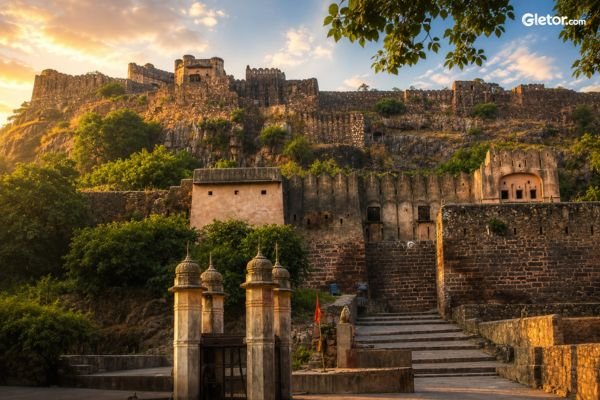
Ranthambore Fort - UNESCO World Heritage Site
10th
Century Origin
700ft
Elevation
2013
UNESCO Status
Hill
Fort Location
Top Attractions

What to See at Ranthambore Fort

The fort complex houses several remarkable structures, temples, and historical sites that tell the story of centuries past.

Ganesh Temple (Trinetra Ganesh)

One of the oldest Ganesh temples in India, believed to have three eyes (Trinetra). Thousands of devotees visit daily to seek blessings.

Royal Palace Ruins

Ancient palaces of the Chauhan rulers and later Mughal governors, showcasing exquisite Rajput and Islamic architectural elements.

Ancient Reservoirs

Step-wells and water tanks built centuries ago to store rainwater, demonstrating the advanced water management systems of the era.

72 Temples Complex

A cluster of 72 ancient temples within the fort walls, dedicated to various Hindu deities, featuring intricate stone carvings.

Massive Fort Walls

The fort features seven gates (pols), massive stone walls, and defensive structures that withstood numerous sieges throughout history.

Panoramic Viewpoints

Stunning viewpoints from the fort walls offering 360-degree views of Ranthambore National Park, lakes, and the Aravalli hills.

Through the Ages

History of Ranthambore Fort

From its founding in the 10th century to its current status as a UNESCO World Heritage Site.

944 AD

Foundation by Chauhan Rajputs

The fort was originally built by the Chauhan Rajput king, Ajaypal Chauhan, as a strategic military stronghold in the Aravalli hills.

11th Century

Rise of the Chauhan Dynasty

The fort became the capital of the Chauhan rulers and witnessed the legendary battles between Prithviraj Chauhan and Muhammad Ghori.

1301 AD

Alauddin Khilji's Siege

Sultan Alauddin Khilji of the Delhi Sultanate captured the fort after a prolonged siege, ending Chauhan rule over Ranthambore.

15th – 16th Century

Mughal & Rajput Rule

The fort changed hands between various Rajput clans and the Mughal Empire, serving as an important military outpost.

1955

Becomes a Wildlife Sanctuary

The area was declared a wildlife sanctuary, marking the beginning of conservation efforts that would make Ranthambore world-famous.

2013

UNESCO World Heritage Site

Ranthambore Fort was inscribed as a UNESCO World Heritage Site as part of the "Hill Forts of Rajasthan" group.

Plan Your Visit

Visitor Information

Everything you need to know before visiting Ranthambore Fort.

Timings & Entry

  • Open daily from 6:00 AM to 6:00 PM
  • Entry ticket: Nominal forest entry fee
  • Best visited during safari hours
  • Carry water and wear comfortable shoes

How to Reach

  • Located inside Ranthambore National Park
  • 15 km from Sawai Madhopur city center
  • Accessible by Jeep Safari route
  • Nearest railway: Sawai Madhopur (SMR)

Photography Tips

  • Carry a wide-angle lens for panoramic views
  • Early morning light is best for photography
  • Capture wildlife from the fort walls
  • Respect heritage structures while photographing

Important Tips

  • Wear sturdy shoes for climbing fort steps
  • Carry a valid photo ID for park entry
  • Do not litter or damage heritage structures
  • Hire a guide for detailed historical insights
Frequently Asked Questions

Ranthambore Fort FAQs

How old is Ranthambore Fort?
Ranthambore Fort dates back to the 10th century (around 944 AD), making it over 1,000 years old. It was built by the Chauhan Rajput rulers.
Is there a separate entry fee for the fort?
The fort is located inside Ranthambore National Park, so you need a valid park entry ticket to reach it. There is no separate fee for the fort itself.
How long does it take to explore the fort?
A complete tour of the fort typically takes 2 to 3 hours, depending on your pace and interest in history and photography.
Can I visit the Ganesh Temple inside the fort?
Yes, the famous Trinetra Ganesh Temple is open to all visitors. It is one of the oldest Ganesh temples in India and is an active place of worship.
Can I drive to the fort?
Private vehicles are not allowed inside the park. You can reach the fort by Jeep Safari or Canter Safari, both of which pass through the park gates.

Plan Your Visit

Need help planning your trip to Ranthambore Fort? We can assist with safari bookings, travel guidance, and more.

Call Us

Explore Ranthambore Fort with a Safari

Book a Jeep or Canter Safari to visit the fort and experience the incredible wildlife of Ranthambore National Park in one trip.